What’s your ideal day to get this newsletter? We’ve been testing different days! So far Fridays, Sundays, and Mondays are leading the pack. Let us know if you have a preference!


Brought to you by Primer – Primer unlocks B2C ad channels for B2B marketers with precision targeting and next-gen measurement.
There are two ways you’re wasting ad budget: (a) you pay to reach people who will never buy, and (b) the buyers who do show up walk away unidentified. Primer fixes both. This includes excluding the wrong people across Meta and Google before you pay for the impression. No more burning budget on students, competitors, and tire-kickers.
You get unlimited website reveals: every account researching you, identified – no caps, no per-reveal pricing. See who is actually in-market and feed it straight back into targeting.
GTMnow Network exclusive offer: Extended 45 day trial and 15% off with code GTM15 – just apply the code when you go to upgrade from the free trial.
See who’s really in your funnel: sayprimer.com

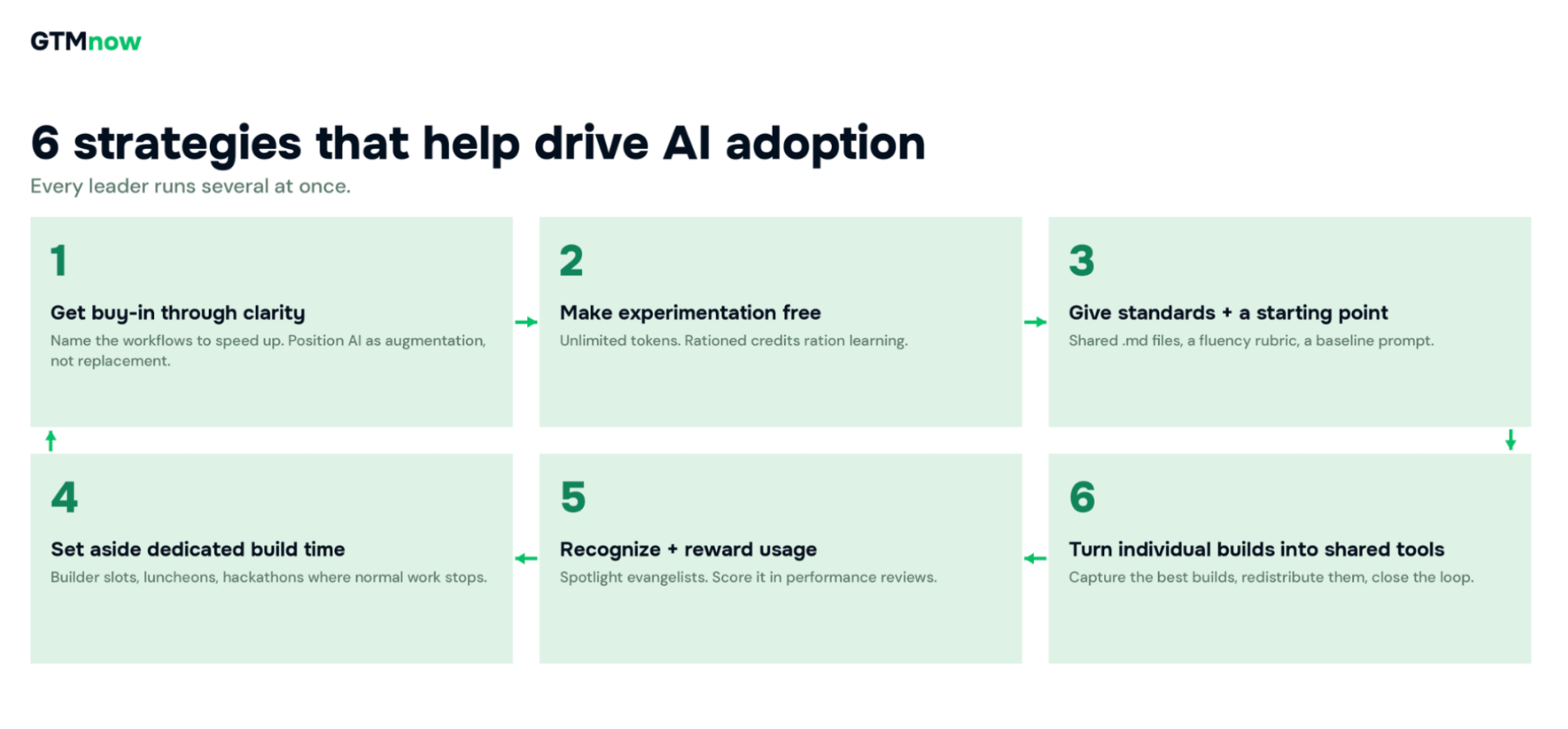
How fast your team adopts AI sets the speed of your go-to-market, and your go-to-market sets your growth. That makes driving adoption one of the highest-leverage things a leader can do right now.
Despite us having access to AI, driving true adoption remains a challenge.
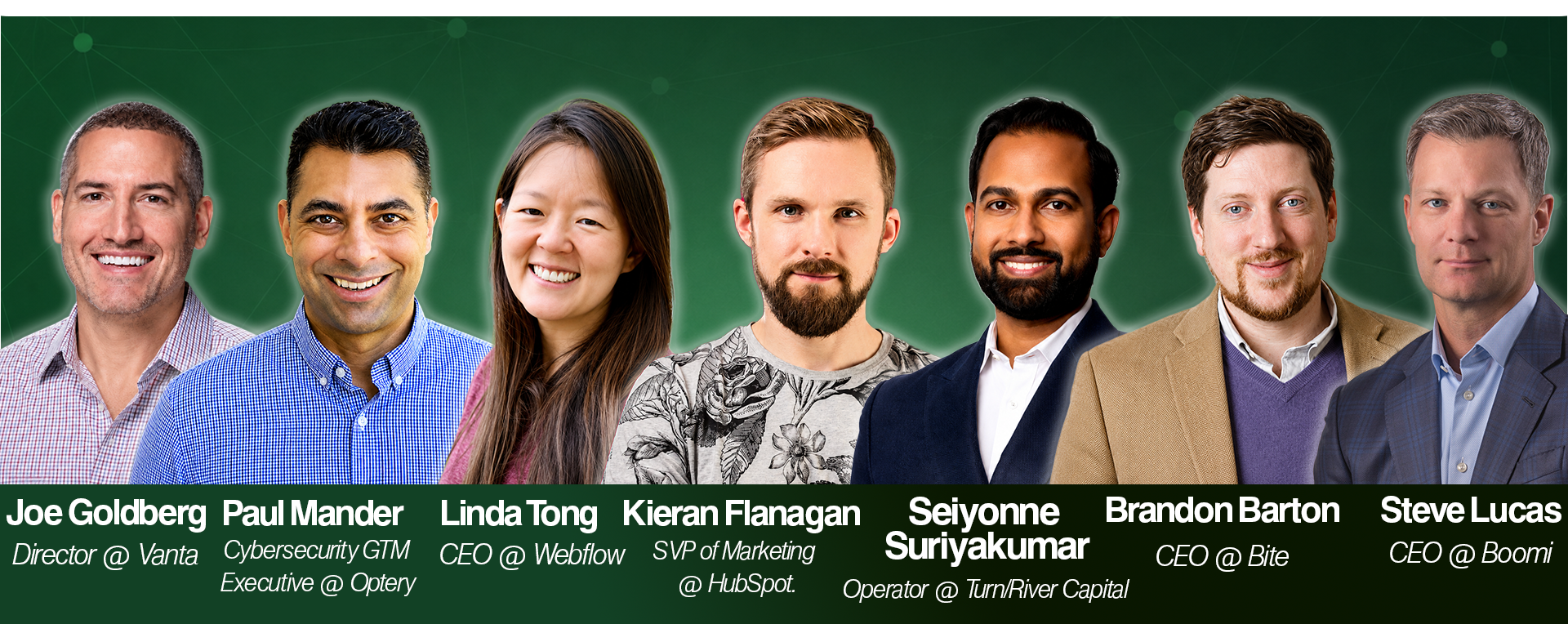
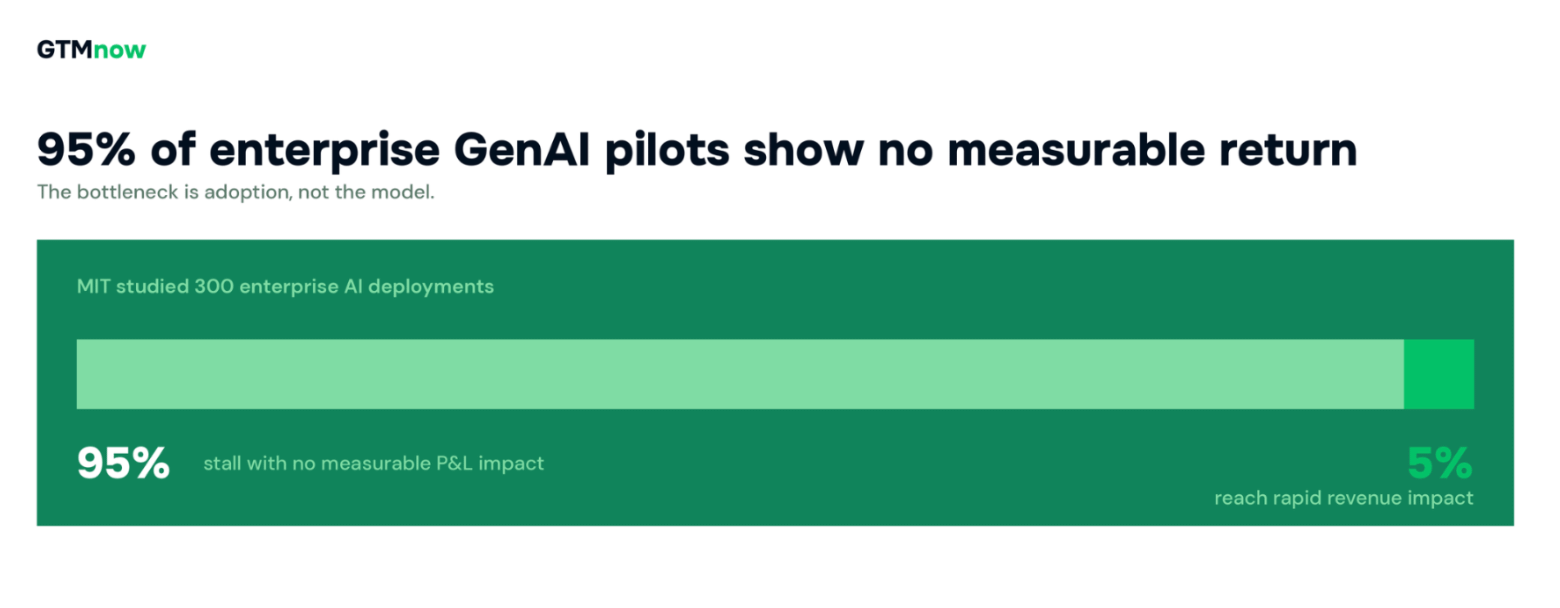
MIT’s NANDA initiative looked at 300 enterprise deployments and found that 95% of GenAI pilots delivered no measurable P&L impact. The reflex is to blame the model. The data says otherwise: the gap is integration and adoption, not model quality. People are already using AI on their own (a “shadow AI economy”), but the value only compounds when a whole team adopts it together. So we asked 21 GTM leaders how they actually drive that inside their companies.
This edition breaks down the six strategies that drove the most upside, each with a real example you can borrow.
1. Get buy-in through clarity
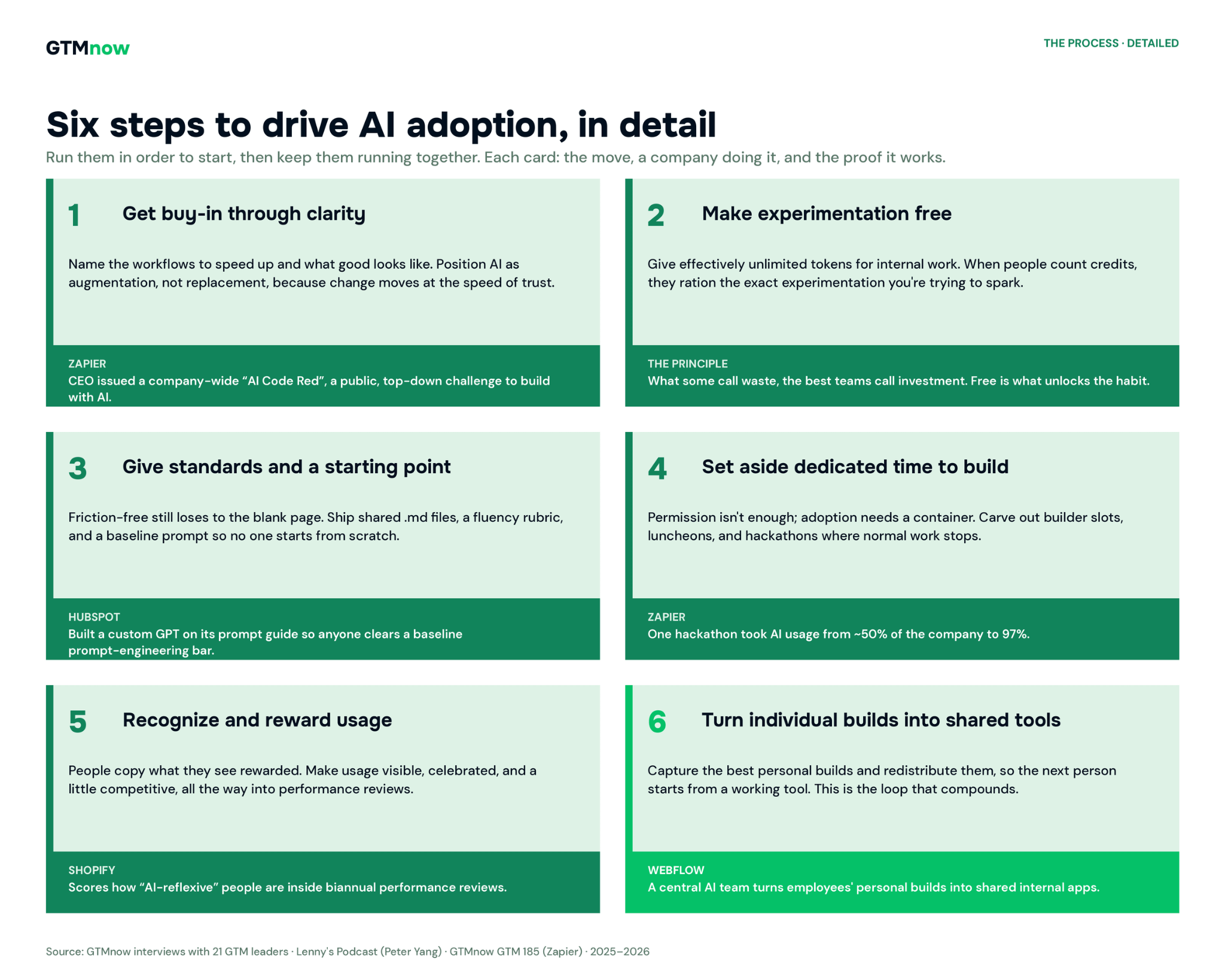
People thrive on goal clarity, and “use AI more” is too vague to act on. Define what you’re actually trying to achieve: which workflows you want to speed up, what good looks like, and how you’ll know it’s working. Direction is what turns aimless experimentation into experimentation that compounds.
The harder blocker is fear. Leaders who pushed adoption without naming the why ran straight into it, because fear that AI is a replacement can foster in people. It isn’t, and you have to say so out loud. Position AI as augmentation, then prove it by pointing at the tedious work it removes, not the headcount it threatens.
Zapier is a great example of clarity. In 2023, CEO Wade Foster issued a company-wide “AI Code Red,” a public challenge to get hands-on and find practical ways to build the company with AI. It worked because it came from the top and framed AI as a shared responsibility for efficiency (not human replacement).
Change only happens at the speed of trust.
2. Make experimentation free*
People won’t explore if they’re counting credits. When every prompt feels like spending money, they ration experimentation, and rationed experimentation bottlenecks the exact learning you’re trying to create. Take the cost of trying down to zero: giving people effectively unlimited tokens for internal work can be an effective strategy.
*While this was consistently a top strategy for leaders, it also comes with the caveat that many organizations are pulling back on unlimited tokens. For example, Amazon pulled back on internal leaderboards that tracked employee AI token consumption after staff engaged in “tokenmaxxing.”
Token usage is great to encourage, but usage is an input, not an outcome. Track it early as a nudge to get people in the tool, then shift to what comes out the other side: hours saved, tools shipped, workflows replaced, and roles you no longer need to backfill.
3. Give people standards and a starting point
Friction-free still loses to the blank page. Free, unlimited access means nothing if everyone starts from scratch every time or doesn’t have a benchmark standard for building.
Zapier built a four-tier AI fluency rubric, with levels running from Unacceptable to Acceptable to Adaptive to Transformative, by asking its own power users in each function what baseline AI skill should look like. That way, “good” becomes gradable.
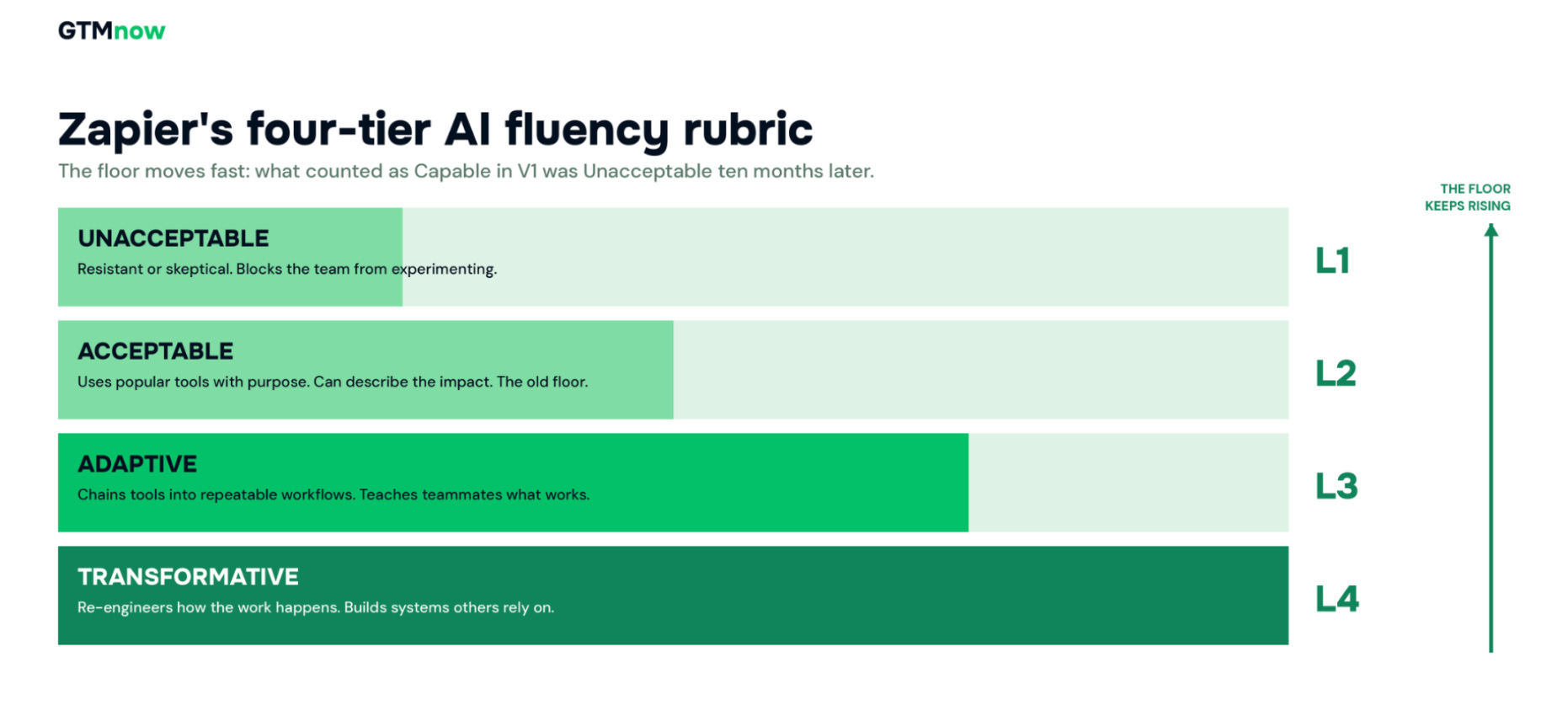
And the bar moves fast: behavior that counted as the floor in the first version of the rubric was reclassified as unacceptable, roughly ten months later. As Zapier puts it, what they now watch is slope, not just where someone sits today, but also how fast they’re climbing.
Pair the rubric with shared assets. Distribute standard .md files for the things every prompt needs (your ICP, your voice, your data definitions), so people inherit context instead of rebuilding it. And treat prompting as a skill people learn, not a talent they have: HubSpot’s teams leaned on a custom GPT built on a prompt guide so anyone could clear a baseline prompt-engineering bar from day one.
If you’re not using this stuff coming into the company, you’re just going to be behind. At this point, it’s a job requirement to be successful inside a company.
Leaders have pushed this all the way into hiring. For example, Nooks tests for AI-literacy by handing the candidate an unfamiliar AI tool and watching how they approach learning it. You’re not testing tool knowledge, you’re testing slope.
4. Set aside dedicated time to build
Permission isn’t enough, adoption needs a container. Telling people they’re allowed to use AI does little if their calendar is still full of the work AI was supposed to absorb. Leaders have found success by carving out protected time where standard work pauses and people build and ship internal workflows.
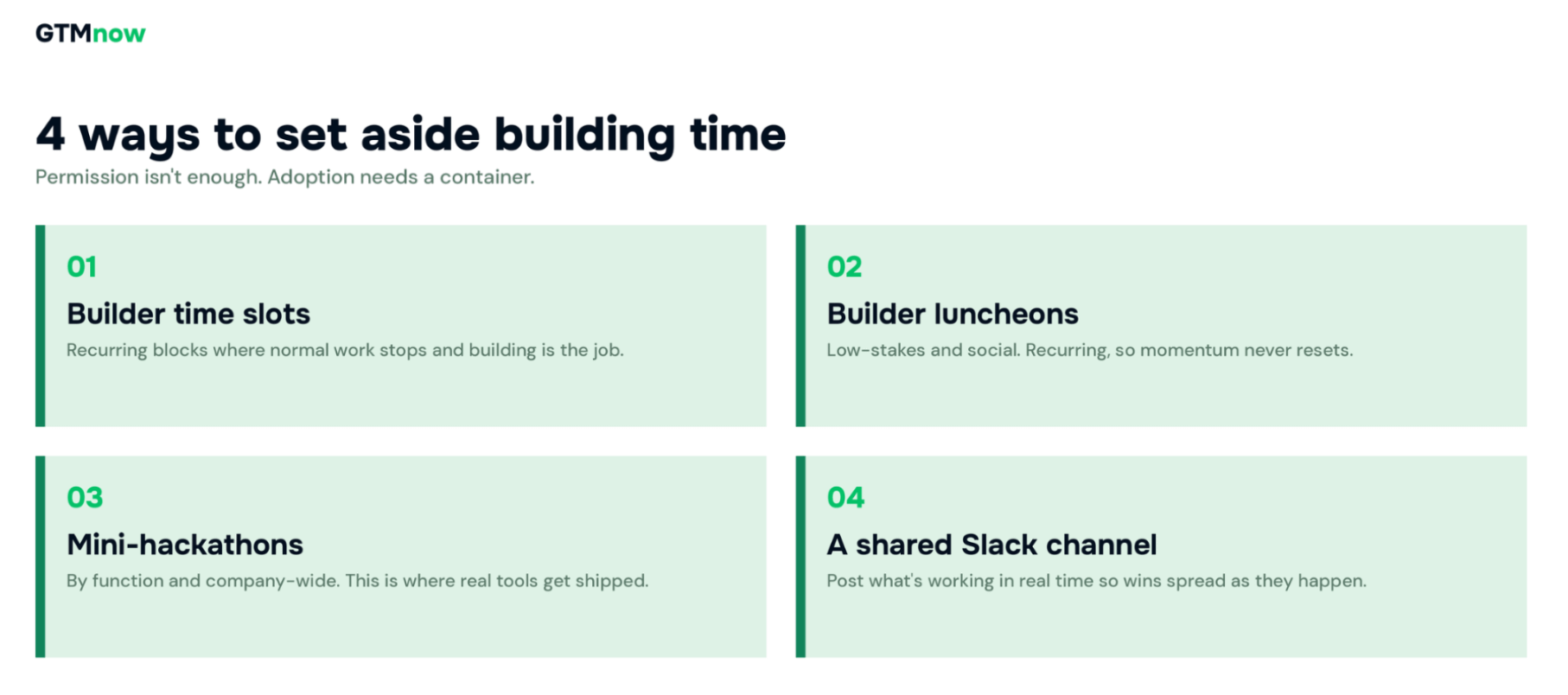
The best returns leaders see is when they run several containers, not one. Carve out recurring builder time slots where building is the job for the hour, host builder luncheons to make it social and low-stakes, run mini-hackathons both by function and company-wide, keep a shared Slack channel running where people post what’s working in real time.
The container does two things at once: It gives permission for a place to land, and it manufactures the proof points that the next four sections need.
5. Recognize and reward the people using AI
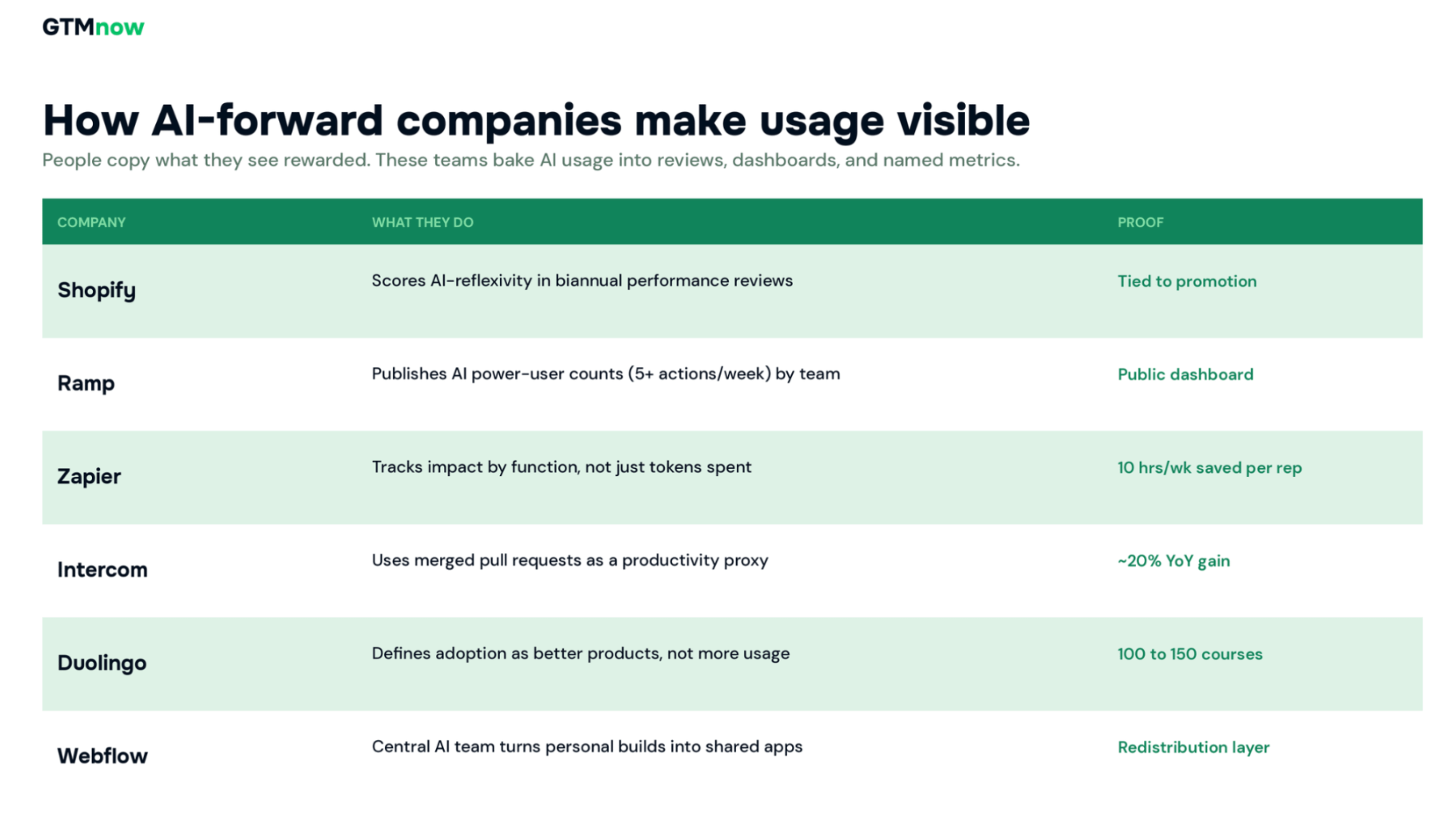
People copy what they see rewarded. If the team watches early adopters get spotlight, status, and resources, more of them follow. If AI usage stays invisible, it stays optional. So make it visible, celebrated, and a little competitive.
Start by reframing your own job. The instinct is to teach people how you did it; the better posture is, “We’re going to figure this out together.” Call yourself the chief figure-it-out officer. It lowers the bar for everyone else because the leader is openly learning in public too.
Arm evangelists with a stage, a spotlight, and more investment dollars. Make them superstars at the company so they can inspire others and keep building (-Sei Suriyakumar)
Everyone measures differently. For example, Shopify scores how “AI-reflexive” people are in biannual performance reviews, how fast they reach for AI when they hit a problem. Ramp publishes AI power-user counts (5+ actions a week) by team for tools like Cursor, Claude Code, and ChatGPT, so the transparency itself creates accountability. Intercom set a “2x productivity” goal and tracks merged pull requests as the proxy.
The lighter-weight tactics stack on top. Brandon Barton would add over-celebrating small wins with new adopters, because the first build is the one most likely to never happen. Joe Goldberg points to internal leaderboards and light gamification to keep usage top of mind. None of these are expensive. All of them signal the same thing: this is what we value now.
6. Turn individual builds into shared tools
The first five moves create a pile of personal builds. The sixth is what turns that pile into compounding leverage: capture the best ones and redistribute them, so the next person starts from a working tool instead of a blank prompt. Done well, the whole thing becomes a loop, where every build lowers the cost of the next one.
Webflow operationalized this with a central AI team whose job is to turn personal builds into shared apps. An individual solves their own problem once and then the central team productizes it for everyone.
Tag @GTMnow so we can see your takeaways and help amplify them.

Zoom is acquiring Common Room to close the loop on its AI revenue platform. Common Room turns fragmented buyer signals into person-level intelligence — so reps know who’s in-market before the call ever happens.
HubSpot is acquiring Warmly, the AI agent platform for marketing and sales teams. 223 paying customers integrated with HubSpot, six pivots to get there. A natural landing spot for a product that was built on HubSpot from day one.
James Underhill, Head of GTM Ops at Profound, on why the business partner role is disappearing. Give field leaders direct data access and the intermediary vanishes. GTM engineering now requires actual engineers — GitHub fluency is his hiring proxy.

GTM: Why a $1.2B exit felt like his biggest failure, and the customer-obsession thesis behind Agency
Listen through the links in the page above or by searching wherever you get your podcasts “The GTMnow Podcast.”

8090 – raised $135M Series A led by Salesforce, which is Chamath Palihapitiya’s AI Software Factory for regulated industries. Builds, refactors, and accelerates entire systems for healthcare, insurance, aerospace, and the US government.
Pocket – raised $11M from Accel and YC, a $129 credit card-sized puck that sticks to your phone and records conversations so you stay present instead of taking notes. 130,000 units sold since launch, no subscription required for core features.
Taxwire – raised $25M Series A led by Headline VC to take sales tax completely off the plate of finance teams. $600B remitted in US sales tax annually — it never goes away and always lands on people who never signed up for it.

-
Founding GTM at Passionfroot (Hybrid – New York, NY)
-
Head of Client Deployment at Passionfroot (New York, NY)
-
Manager, Mid-Market Customer Success at Noibu (Hybrid – Ottawa, Ontario)
-
Customer Success Manager – Enteprise (US/Canada) at Owner (Remote – US/Canada)
-
Senior Customer Success Manager – Enterprise at Gorgias (Remote – US)
-
Director of Customer Success at Closinglock (Austin, TX)
See more top GTM jobs on the GTMfund Job Board.

Upcoming events you won’t want to miss:
-
Lenny & Friends Summit: September 10, 2026 (San Francisco, CA)
-
Dreamforce 2026: September 15–17, 2026 (San Francisco, CA)
-
INBOUND: September 16–18, 2026 (Boston, MA)
-
Pavilion GTM2026: September 28–October 1, 2026 (NYC, NY)
-
Moment 2026: October 6, 2026 (NYC, NY)
-
CVC Week by Counterpart Ventures: September 29, 2026 (San Francisco, CA)
-
Customer Success Week: October 5-9, 2026 (NYC, NY)
-
TechCrunch DISRUPT: October 13–15, 2026 (San Francisco, CA)
-
GTMfund AGM/Retreat: October 15-17, 2026 (San Francisco & Napa, CA)

Some GTMnow Network love to close it out – we appreciate you.

