Hey, I’ve been in digital marketing for years, helping businesses of all sizes grow their customer base and revenue. Through countless campaigns and strategy sessions, one thing has always stood out: email marketing statistics prove this channel delivers real, measurable results year after year.
In 2026, it’s not just surviving, it’s thriving with smarter tools and better strategies. If you’re looking to connect with your audience, boost sales, and build loyalty without wasting budget, you’re in the right place. Let’s break down the latest insights so you can make confident decisions for your business.
What I’ve learned from working with teams is that email feels personal and direct in a noisy world. Customers appreciate value in their inbox, and the numbers back it up big time. Whether you’re a small business owner or part of a larger team, these email marketing statistics will show you exactly where the opportunities are, and how to grab them. I’ll keep everything straightforward so you can apply it right away.
Ready to see why email marketing remains one of the smartest investments you can make? Let’s get started.
What Are Email Marketing Statistics?
Email marketing statistics are the data points that show how well email performs as a marketing channel. This includes numbers around reach, ROI, open rates, click through rates, subscriber growth, and newer trends like AI personalization and automation.
Businesses use these numbers in two ways. First, as a benchmark, so you know whether your own open rate, click rate, or ROI is above or below what similar businesses are seeing. Second, as a guide for strategy, since the data shows what is actually working right now, not just what worked a few years ago.
In 2026, these numbers point to one clear conclusion. Email is not fading out, it is getting smarter, more automated, and more personal, which makes it one of the most dependable channels for growing a business.
The Big Picture: Reach and Growth of Email Marketing
These numbers highlight just how massive and reliable email’s audience is in 2026. Understanding the scale helps you see why investing time here makes sense for reaching and growing your customer base.
- There are about 4.59 billion email users worldwide in 2025, projected to hit 4.73 billion by 2026, that’s more than half the planet’s population you can potentially reach. (Forbes)
- Around 392.5 billion emails are sent and received every single day in 2026, showing people still rely heavily on email for communication. (Hostinger)
- The number of global email users keeps growing steadily each year, making it one of the most reliable ways to stay in touch with customers. (Statista)
- Gmail alone has over 1.8 billion active accounts, which means your emails have a great chance of landing in popular inboxes. (Forbes)
- Most people manage around 1.86 email accounts on average, giving brands multiple ways to connect. (Statista)
- Email users are expected to approach 4.89 billion by 2027, underlining long-term growth for your marketing efforts. (Statista)
- Over 83% of internet users have an email account, giving email massive built-in reach. (Stripo Research)
- Small businesses are catching on fast, 64% now use email marketing to grow their customer relationships. (Forbes)
- Daily email volume is climbing, with projections heading toward 408 billion+ messages soon. (Hostinger)
- Email remains a core professional and personal tool, with 14x more users than popular chat apps like Slack or Teams. (Mailover)
Email Marketing ROI Statistics: Proven Returns You Can Count On
This is where email really shines for your bottom line. The ROI numbers explain why so many successful businesses I work with prioritize it over flashier channels.
- Businesses earn an average of $36 to $42 for every $1 spent on email marketing, delivering one of the highest returns in digital channels. (Forbes)
- Some industries see up to $45 back per dollar, especially in retail and ecommerce. (Constant Contact)
- Nearly 1 in 5 companies achieve 7,000% ROI or higher, showing what’s possible with the right approach. (Email Monday)
- Email marketing is rated as the highest ROI channel by around 30% of marketers, with many more calling it strong. (Omnisend)
- For every 1,000 subscribers, you can generate about $3,200 per month on average in revenue. (Entrepreneurshq)
- Companies believe email boosts customer retention by 15%, helping you keep customers longer and more profitably. (Entrepreneurshq)
- Automated emails drive 37% of email-generated sales even though they make up just a small percentage of total sends. (Omnisend)
- Global marketers consistently rate email marketing as having the highest ROI among digital channels, with 30% citing it as their top performer and another 43% rating it as having medium-to-high ROI. (Statista)
- Top performers regularly see 3,600% to 4,200% returns, making email a no-brainer for sustainable growth. (Verified Email)
- Email marketing revenue worldwide continues to grow steadily into the billions, reflecting strong business adoption. (Statista)
Engagement Stats: Opens, Clicks, and What Works
Knowing these benchmarks helps you set realistic goals and improve your own campaigns step by step. Here’s what actual performance looks like across different types of emails.
- Average email open rates sit around 21-36% across industries, with strong campaigns pushing much higher. (Forbes)
- Personalized subject lines or AI-generated ones can lift open rates by up to 26%. (Codecrew)
- Click-through rates average 1.4-2.6%, but automated flows often hit 5% or more. (Klaviyo)
- Mobile devices account for 55-62% of all email opens, so design must work perfectly on phones. (Stripo Research)
- Non-profits and faith-based organizations often see open rates of 40-45%+. (Mailchimp)
- B2B median open rates range from 36.7% to 42%, showing strong professional engagement. (Verified Email)
- The average click-to-open rate (CTOR) for marketing emails typically ranges from 10% to 25%, with top-performing campaigns often exceeding this benchmark and showing strong audience interest. (Dyspatch)
- Top 10% of performers achieve open rates above 45%. (Klaviyo)
- Unsubscribe rates stay low at around 0.1-0.2% when you deliver value. (Dyspatch)
- Automated emails generate 320% more revenue than non-automated ones in many cases. (Optimonster)
Trends and Future-Proof Stats for 2026
The future of email is exciting and customer-focused. These trends show how you can stay ahead while building better relationships.
- Over 87% of marketers are using or exploring AI for email content and personalization. (Stripo Research)
- By 2028, 60% of brands will use autonomous AI agents for one-to-one email interactions. (Gartner)
- Privacy and consent are top priorities, helping build more trusted and effective lists. (Litmus)
- Personalized email marketing can deliver up to 20% higher revenue and significantly improved customer loyalty compared to non-personalized campaigns. (Statista)
- Interactive elements like quizzes inside emails boost engagement significantly. (Insiderone)
- Segmentation remains one of the most effective strategies for higher opens and clicks. (Statista)
- Email is the channel that relies most on marketing automation (58% of professionals). (Statista)
- Consistent brand experiences across channels make customers more receptive to emails. (Statista)
- AI helps with automatic content generation, images, and better timing. (Statista)
- Focus on education and authenticity over hard selling works best in 2026. (Forbes)
- Shorter subject lines and one clear message per email perform strongly. (Benchmarkemail)
- Light personalization combined with strong segmentation lifts results. (Benchmarkemail)
- Bold design, accessible content, and mobile-first approaches are key trends. (Mailjet)
- Retail and consumer goods industries lead in email ROI. (Forbes)
- Conversion rates and click-through rates are the top metrics marketers track after opens. (Statista)
- Many marketers report improved ROI in their email campaigns year over year. (Statista)
- Email supports loyalty programs and rewards that customers love. (Statista)
- Deliverability remains strong when following best practices on consent. (Statista)
- Small businesses see email as a top valuable channel for 2026. (Constant Contact)
- AI-powered predictive analytics and behavior triggers are becoming standard. (Insider One)
- Flow-based emails deliver up to 13x higher order rates than campaigns. (Klaviyo)
- Over half of marketers in key regions say AI makes email more effective. (Statista)
- Subject line personalization rates are rising across campaigns. (Statista)
- Email marketing market value is projected to keep expanding rapidly. (Hostinger)
- Additional benchmarks show strong performance in finance, travel, and education sectors, with ongoing gains from testing and optimization. (Statista)
How Does a CRM Help You Act on These Email Stats?
Reading the stats is one thing, acting on them consistently is another. This is where having the right system in place makes a real difference.
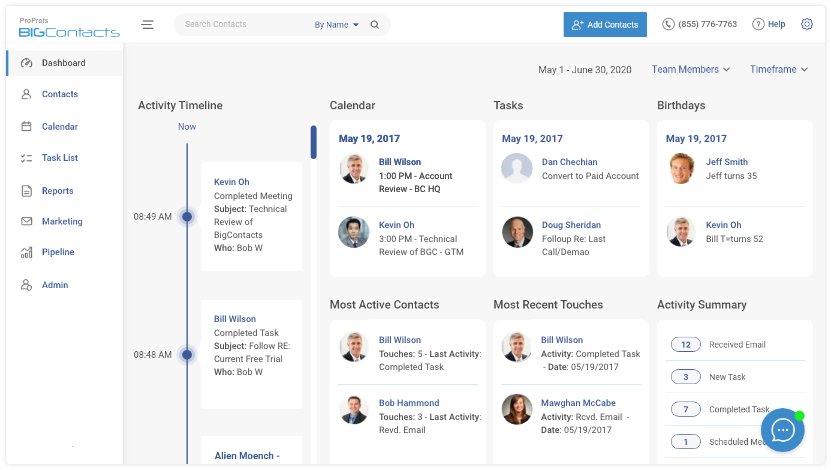
BIGContacts by ProProfs is a simple, affordable CRM built for growing small businesses, with contact management, email marketing, task automation, and sales pipeline tracking all in one place. Instead of guessing who to email and when, you can segment your list based on real contact activity, automate follow ups, and track opens and clicks without jumping between five different tools.
For a small business trying to hit those 21% to 36% open rate benchmarks, that kind of visibility matters. You can see which contacts are engaging, which ones have gone quiet, and where to focus your next campaign. BIGContacts also comes with a forever free plan, so you can start applying these strategies without committing to a big budget upfront.
Turn These Email Marketing Stats Into Real Results
The data is clear. Email marketing is not just holding steady in 2026, it is getting stronger, smarter, and more personal thanks to automation and AI. From strong ROI to rising open rates in the right conditions, the opportunity is there for any business willing to put in the work.
The real difference between businesses that win with email and those that do not usually comes down to consistency. Segment your list, personalize where it counts, automate the repetitive parts, and keep testing what resonates with your audience.
If you are looking for a simple way to manage contacts, automate emails, and track what is working without hours of training or a big budget, a tool like BIGContacts makes it easy to get started and stay consistent.
Frequently Asked Questions
Is email marketing still effective in 2026?
Yes, email marketing remains highly effective in 2026. Businesses continue to see returns of $36 to $42 for every $1 spent, making it one of the highest ROI channels available today.
What is a good email open rate in 2026?
A good open rate typically falls between 21% and 36%, depending on your industry. Non profits and B2B brands often see higher averages, sometimes reaching 40% or more.
What is a good click through rate for email marketing?
Most industries average a click through rate between 1.4% and 2.6%. Automated email flows tend to perform better, often reaching 5% or higher.
What is the average ROI of email marketing?
The average ROI for email marketing sits between $36 and $42 for every $1 spent, with some industries like retail seeing returns as high as $45 per dollar.
How many people use email worldwide?
There are approximately 4.59 billion email users worldwide as of 2025, with that number projected to grow to 4.73 billion by 2026 and nearly 4.89 billion by 2027.
How is AI changing email marketing?
AI is helping marketers personalize subject lines, generate content, and time sends more effectively. Over 87% of marketers already use or are testing AI tools for email in 2026.
What percentage of email sales come from automation?
Automated emails generate 37% of all email driven sales, despite representing a small share of total emails sent, which shows how powerful even simple automation can be.
Why do unsubscribe rates matter?
Unsubscribe rates show whether your content matches subscriber expectations. Healthy rates stay around 0.1% to 0.2%, and anything higher usually signals a need to slow down sending frequency or improve relevance.
How can small businesses improve their email marketing results?
Small businesses can improve results by segmenting their list, personalizing subject lines, automating follow ups, and reviewing performance regularly. A CRM with built in email tools, like BIGContacts, can simplify this process significantly.
What industries see the highest email marketing ROI?
Retail and consumer goods industries currently lead in email marketing ROI, though finance, travel, and education sectors also report strong and improving performance.
Do I need a CRM to run effective email marketing campaigns?
A CRM is not strictly required, but it makes segmentation, automation, and tracking much easier. Tools like BIGContacts combine contact management and email marketing in one place, which saves time compared to managing spreadsheets and email tools separately.