A customer calls their insurance company with a straightforward question about their deductible. The agent pulls from a knowledge base that hasn’t been updated in two years and quotes the wrong number. It won’t throw an error. It won’t trigger an alert. The customer gets an answer that sounds confident and mostly right. If it’s wrong enough to matter, you’ll find out after the fact when they submit a complaint or post an angry tweet.
This is the predictable consequence of how most organizations have approached enterprise AI: deploy fast, declare success at launch and leave the hard questions about ongoing ownership for later. The agents get built. The accountability structures don’t. And because agents drift rather than crash — giving answers that are confident, plausible and wrong — nobody notices until it’s already a problem.
The issue isn’t the technology itself. The agent works. What’s missing are the people whose job starts where the build ends: monitoring performance, catching drift, deciding when something needs to change. Every other critical system has someone whose job it is to keep the lights on. Most agents don’t. To help fill that gap, we developed the Agent Development Lifecycle (ADLC), an end-to-end framework for developing, monitoring and operating enterprise AI agents.
Software fails loudly. Agents drift.
Traditional software tells you when it breaks. A failed deploy throws errors. A crashed service returns 500s. An outage pages someone at 2am. Decades of operational practice — the runbooks, the on-call rotations, the SLOs — were built on this basic property: failures are visible, and visible failures create pressure to respond.
Agents fail differently. Instead of crashing, they continue to confidently give incorrect answers based on whatever context they have, with no signal that anything is wrong. The failure is invisible to every instrument the software playbook was built to catch.
An agent that was accurate at launch can degrade silently as knowledge bases age, policies update, user behavior evolves and edge cases accumulate. None of that shows up as an error. The agent just gets a little less right, a little more often, until someone notices. That isn’t a monitoring gap that better dashboards can solve. It’s a structural accountability problem that requires dedicated roles and feedback loops.
The ADLC defines roles that don’t exist on most org charts yet
The ADLC is a framework built specifically for this problem. It defines who owns each phase of an agent’s lifespan, from planning and building to monitoring and iteration. Those stakeholders are:
Chief AI Officer: Translates business objectives into measurable agent outcomes, defining what good performance looks like before a single line of configuration is written.
Agent Builder: Implements the agent’s core functionality and ensures technical quality, connecting data sources, configuring instructions, and building the operational layer.
Agent Tester: Ensures agents perform reliably across diverse scenarios before they reach users, systematically probing for failure modes in controlled conditions.
Agent QA Lead: Identifies and diagnoses agent quality issues in pre-production, surfacing which subagents produce poor responses and routing problems to the right person to fix them.
Agent Supervisor: Regularly monitors live agent performance, identifies issues requiring intervention, and decides when to act.
Most of these roles don’t exist in most org charts today. Some map loosely onto existing titles — a QA engineer, a product manager, an ops lead — but the job isn’t the same. Testing an AI agent requires evaluating stochastic outputs against evolving criteria, not checking whether a function returns the expected value. Monitoring an agent requires reading transcripts, labeling conversations, and interpreting behavioral data, not watching an uptime dashboard.
Operating an agent is a practice, not a project
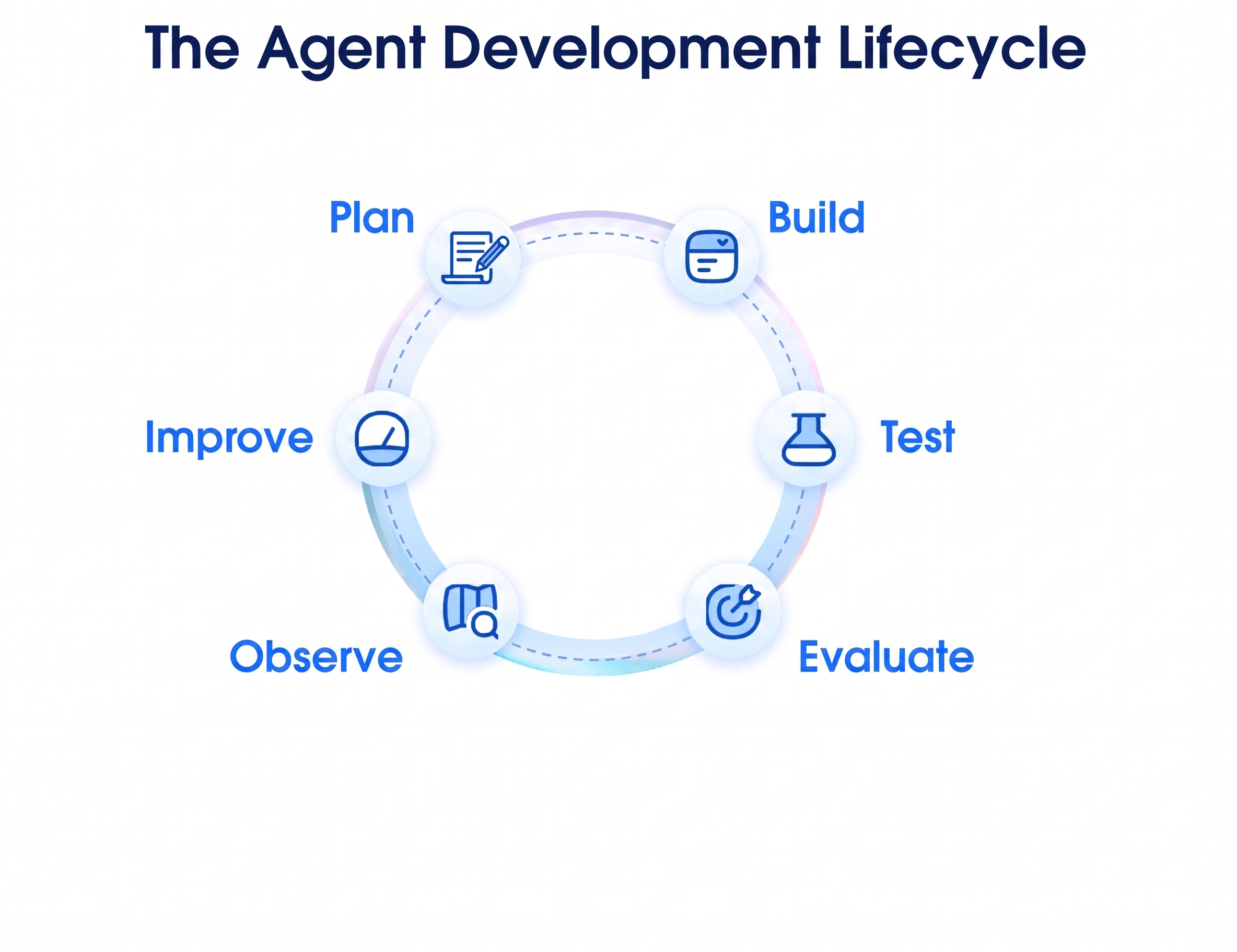
Once you’ve assigned your ADLC roles, it’s time to map them against each stage of the agentic lifecycle. The ADLC structures agent operations into six distinct phases, each with defined owners and a specific job to do:
Plan — Define success criteria upfront: what the agent is supposed to do, what good performance looks like, and who owns the outcomes. These are the benchmarks every downstream phase is measured against.
Build — Design and develop the agent against those criteria, with the operational layer (roles, monitoring, feedback loops) scoped from the start, not bolted on after launch.
Test — Establish the foundation with rigorous pre-production testing that validates reliability before users encounter the agent, not after.
Evaluate — Surface how the agent actually performs once it’s live: which subagents produce poor responses, where intent mismatches cluster, and how often users have to rephrase a query just to get a usable answer.
Observe — Turn that analysis into a clear picture of what’s degrading and why, separating problems that require a prompt change from those that require deeper work on the underlying knowledge architecture.
Improve — Diagnose the root cause, make a targeted change, and measure it against your planning metrics, prioritizing the fixes that move business value and scaling the ones that work across your other agents.
The ADLC is designed as a virtuous loop. Each pass creates a cleaner baseline for the next iteration — better-defined success criteria, a sharper sense of where the agent tends to fail, faster paths from observation to fix. That doesn’t happen because the technology gets smarter. It happens because the people running it get better at their jobs. They’ve seen the failure modes before. They know which metrics to watch and which are noise.
For most enterprises, that cycle hasn’t started yet. The companies pulling ahead aren’t smarter or better resourced, they simply made a structural call that’s been paying dividends since day one.
For a deeper look at how the ADLC works in practice, check out The Grown-Up’s Guide to Operating an Agentic Enterprise.