AI made the production side of paid marketing nearly free. Copy, creative variants, landing pages, ad ops – all of it has collapsed in cost. And yet most B2B paid programs aren’t scaling any better than they were three years ago.
That’s because the constraint moved. AI hasn’t produced a new social network or a new place for people to spend their attention. It’s just glutted the channels we already have with more content. Some of that content is…mediocre 🙂
When you can produce more, you run more ads and create more demand, but the supply of attention hasn’t grown to keep pace. There are no extra eyeballs. More ads chasing the same people just raises the price of being seen.
So the real differentiation in paid isn’t creative anymore. Creative is free now (though taste isn’t!). Now, it’s who you target, where you reach them, how you measure it, and how fast you learn.
This playbook breaks it into three parts: the audience layer that competitors can’t copy, a channel-by-channel read on what’s actually working, and what’s coming next with AI.

Part 1 — Audience: the layer competitors can’t copy
The hardest thing for a competitor to copy is your targeting. They can figure out your channels, reverse-engineer your creative, and imitate your messaging – all of that is visible. But they can’t see your targeting. That makes audience a durable advantage in paid.
Build one ICP audience and run it everywhere
Ad platforms only optimize against data inside their own walls. They don’t know your real ICP, which titles actually convert to customers, your win-loss rate by category, who’s already a customer, or who you lost to a competitor. The only way they get that signal is if you push it in.
How to build this: Build one ICP audience, layer CRM data to exclude existing customers and competitors, then sync the same enriched audience across Meta, Google, LinkedIn, and Reddit. Same audience, same exclusions, every channel.
And if all these platforms are telling you to trust the algorithm, then the only real lever you have is the signal you feed it. Optimize for form submits and the algorithm will happily find you the cheapest form submits, quality be damned. You have to push CRM conversion data back in so it optimizes for revenue. Meta’s algorithm in particular has gotten very good at this, very fast. For most B2B teams, the model to aim for is small audience, high penetration, particularly on LinkedIn. Not a big audience reached once, hoping for the best.
Match rates are the unlock, and they vary by persona
The reason most B2B teams can’t use the cheaper channels is because of identity. Upload a list of work emails to Google, Meta or Reddit and you get a 2-10% match rate, because nobody signs up for those platforms with their work email. Resolve the identity first and the same list matches at roughly 80% on Meta, 50% on Google, and 70% on Reddit.
Primer customers report a similar pattern: enriching audience lists with B2C identifiers like personal emails and mobile numbers from consent-compliant sources lift Meta match rates from around 10-20% to over 75%, and turned their campaigns from almost unusable into, on average, a $50 cost per qualified lead on Facebook.

But match rates aren’t uniform, they’re a map of where each persona actually spends time. Reddit match rates run 70-80% for IT and engineering audiences and drop to around 4% for legal and procurement. Doctors aren’t really on LinkedIn, neither are most people in education. And remember, almost every Gen Z or millenial doom scrolls either Instagram, Tiktok, or X at night. Your channel mix should follow your persona’s match rate, not the industry default. Targeting is the one thing a competitor can’t reverse-engineer. Resolve identity first, and the cheap channels open up.
Buy credibility, don’t just buy impressions
Look at what happened in B2C: people stopped wanting to hear from brands and started trusting individuals. That shift is now hitting B2B, and we’re only at the beginning of it. One of the fastest ways to grow is to buy credibility from people who already have the audience, rather than trying to manufacture it yourself as a brand. Influencer marketing is coming for B2B.
There are paid vehicles for this that almost nobody is using well. On Meta you’ve long been able to get whitelisted access to a creator’s account and run ads as them. LinkedIn shipped the same capability for promoting a thought leader outside your own company. Promoted third-party thought leadership, an outside voice your buyer already trusts, is one of the most undervalued tactics in B2B paid right now.
Measurement is triangulation, not a single source of truth
The biggest measurement mistake in B2B is treating any one attribution model as ground truth. First-touch, last-touch, and multi-touch are each wrong in a different direction. Attribution as a category is where a long list of startups has gone to die. The right approach is triangulation: use multiple signals, look for agreement, and distrust certainty.
Your buyer doesn’t have one device or one identity. They research on mobile in a meeting, click through on desktop at lunch, demo on a personal laptop, and sign from a phone on the way to dinner. Their work email is one identity, their personal login another, and half the time they’re behind a corporate VPN. Most attribution systems assume one device per person and most B2B lists default to work emails. Both assumptions are wrong, and both get more wrong every year. Research increasingly starts on mobile while the closing click still happens on desktop, so mobile-heavy channels get systematically undercounted and the channel that captures the final desktop click gets over-credited.
That produces a bias in budgets. Marketers don’t invest heavily in what they can’t cleanly measure, so they over-invest in channels with the cleanest attribution (LinkedIn and Search) and underinvest in the ones their analytics struggle to see (Meta, Reddit, and YouTube). The channels that look weakest by CAC are often the ones carrying real weight in the journey. You just can’t see it from touch-based attribution.
The fix is running real causal experiments alongside whatever attribution you already use. Embrace holdouts. The simplest version: push an audience into Meta with an equivalent holdout group that doesn’t see the campaign, keep your normal tracking, then compare the conversion rate of the exposed group against the control. That delta is your incremental lift, independent of any platform’s claim. You can get to statistical significance with an audience as small as 5,000 people given enough time, so this isn’t only for the giants.
It’s the same logic Zoom famously ran for years: no digital attribution, just compare exposed markets against control markets. Geo testing works. Across 225 geo-based tests, incrementality benchmarks found branded search posts the lowest incremental ROAS of any channel at 0.70x, meaning much of that spend buys clicks you’d have gotten for free, while platform-reported ROAS routinely runs 2 to 3x inflated and far more on branded and retargeting. The holdout is the cheapest piece of analytics infrastructure most B2B teams still aren’t building.
Triangulate cross-platform data, incrementality, and mix modeling. The holdout is the only number that survives.

The missing piece: benchmark data by persona
The single biggest gap in B2B paid today is benchmark data. There’s no trusted source that aggregates and anonymizes performance by persona and tells you what’s actually working if you’re selling into cybersecurity, or HR, or fintech. Yes, shared benchmarks risk a reversion to the mean, and the best marketers will always take a first-principles approach. But credible peer data would de-risk the investment enormously, and it’s the thing that gets a team spending $1M a month on Google comfortable moving a slice into Meta, or gets a first-time founder to press the on button at all. It’s coming as the data infrastructure matures, and it will reshape how budgets get set.
Part 2 — Channels: a channel-by-channel read
LinkedIn and Search are the B2B defaults for a reason: they work, and they’re the easiest place to start because the ICP filters are built in. But they’re expensive, capped, and most teams hit their ceiling faster than they admit. Here’s the current read on each channel, and where the mispriced attention actually is.
Search
Search has always been the bread-and-butter high-intent channel. That’s changing fast. AI Overviews are eating unbranded search, and your click volume on top-of-funnel terms is declining whether you’ve noticed or not. Pew Research found that when an AI summary appears, only 8% of users click a traditional result, versus 15% when there’s no summary, and a quarter of those sessions end without any click at all. The cheap-discovery model on unbranded is dying.
Two things still convert. The first is competitor conquesting, and it’s broader than people realize. Don’t just bid on your direct rivals. Go after adjacent terms: agencies in your space, tools your prospects already use that solve part of the problem you solve, categories you’re encroaching on. Competitor-intent keywords convert at roughly 10 to 20% form-to-SQL versus 5 to 15% for generic search, and while the clicks cost 30 to 50% more, the cost per qualified opportunity runs 20 to 40% lower. It’s getting more expensive as everyone catches on, but it’s still the highest-ROI search dollar most B2B teams aren’t fully exploiting. (Note that Google keeps AI Overviews off most branded queries, because it still needs to monetize that intent.)
The second is brand and high-intent terms, which still convert but need to be measured honestly (see the holdout point above). As for PMax and AI Max, experiment with eyes open. They’re built for consumer marketers with broad audiences and lots of conversion data. If your TAM is 10,000 accounts and your monthly conversions are in the dozens, you’re not feeding those algorithms enough signal to do anything useful. One B2B advertiser saw an AI Max conversion rate of just 0.76%, the worst match type in the account. If you do run them, sync massive suppression audiences into Google, every bad-fit title, every customer, and every disqualified lead, and let the algorithm spend on what’s left. The clearest sign of the shift: teams keep doubling down on search even at $8K a qualified opportunity, when the better question is whether there’s a cheaper, higher-volume way to get the same result.
Top-of-funnel discovery is collapsing, so the surviving search dollars belong down-funnel where intent is real.

LinkedIn is the other default, and the easiest place to test because the ICP filters live right in the product. But it’s gotten brutal on price. CPMs over the last 18 months have gone from around $20 on average to as high as several hundred dollars with competitive US audiences. So the single most important LinkedIn principle right now is to ride new placements and formats before they get crowded. LinkedIn keeps shipping new inventory, the market takes 12 to 18 months to catch up, and that early window is when CPMs are reasonable and competition is thin.
Messenger ads were the cheap arbitrage two years ago. Not anymore. Thought leadership ads are the current replacement, and the data is hard to argue with: across 119 thought leader ads and more than $300K in spend, they posted a 2.68% median click-through rate compared with 0.42% for single-image ads, at a median cost per click of $2.29. They promote a real person’s post rather than a brand, so they read as credible rather than as an ad. Document ads still perform if you have a genuinely useful, opinionated asset behind them. LinkedIn CTV is the newest window, launched in 2024 with NBCUniversal and expanded to Paramount inventory in 2025, with Salesforce reporting it reached more than 70% of its target audience incrementally. The neat thing about connected TV is that you can’t skip it.
The other thing most teams get wrong on LinkedIn is not being aggressive enough with exclusions. The platform quietly expands your targeting under the hood, showing ads to related job titles, and you end up paying premium CPMs to reach people who don’t match your seniority at all. Roughly 45% of profile titles get clustered into LinkedIn’s broader Super Titles, so a Marketing Specialist can quietly get served under a CMO target. You need tight targeting plus aggressive exclusions on every campaign. Turn off Audience Expansion and the Audience Network, switch location to permanent only, and build an exclusion list that’s often longer than your inclusion list.
The format arbitrage window: new LinkedIn inventory stays cheap for 12 to 18 months before the market floods in.

Meta
Meta is the most underrated channel in B2B paid. Not magic, just mispriced, because everyone else is ignoring it. CPMs on Meta run roughly $7 to $15. On LinkedIn they sit at $31 and climb past $100 with competitive US audiences. That’s not a 2x or 3x edge, it’s closer to an order of magnitude, sitting in plain sight. Your ICP doesn’t stop being human when they close their laptop. They’re on Instagram at night, they scroll Facebook. Even if LinkedIn were cheap, you’d want to be where your buyer actually spends their attention.
The reason B2B teams still skip Meta isn’t strategic, it’s targeting and measurement, and both are getting solved. Out of the box, Meta optimizes toward whoever fills out forms, which in B2B means a lot of the wrong people. Two recent changes fix the worst of it. Meta now supports work-email validation in instant forms, which finally solves the every-lead-is-a-personal-Gmail problem that pushed B2B teams away in the first place. And the real unlock is pushing into your own audiences: your ICP as a custom audience, your closed-won look-alikes built from CRM data, and your suppression list. Combine the match-rate fix above with Meta’s algorithm, which is genuinely excellent, and a channel that used to fail the toe-in-the-water test now works. If you tested Meta a couple of years ago and bounced, it’s worth another run.
One thing to watch: Meta’s algorithm saturates pockets of your audience and over-serves them. Even with great targeting, you have to rotate (refresh audiences, swap in new creative, and layer anti-ICP suppression onto lookalikes), or frequency climbs while incremental conversions flatten.
Meta’s cost-per-thousand advantage over LinkedIn isn’t incremental, and the targeting gap that scared B2B off is closing.

The next tier: Reddit, YouTube, TikTok, programmatic
The pattern beyond Meta is the same: broad-reach channels are mispriced for B2B because the rest of the market won’t use them. Reddit is seeing a real surge in B2B demand, with CPMs that can run under $15. The key on Reddit is making your ad content feel native. A post that reads like a genuine, thoughtful contribution gets engagement; an obvious ad dropped into the middle of a subreddit gets glazed over. YouTube and programmatic display are wide open, and depending on your category, so is TikTok, where a few brave B2B brands are already testing. If you have the audience infrastructure to feed these channels properly, that’s an arbitrage that’s hard to find anywhere else in paid right now.
A note on creative across all of them: platform tooling varies wildly. Meta’s dynamic optimization is the best, Google’s is second, and LinkedIn and Reddit lag well behind. On the algorithmic channels the move is to feed enough variance, formats and messages, and let the system pick the winner. Which is why your ability to iterate and produce variants, especially video, has become a real competitive muscle, not a nice-to-have.
Part 3 — AI: from generation to the analytical frontier
The AI-in-marketing wave so far has been about generation: copy, creative, chat, and landing pages. That’s the easy lift for language models, which are good at producing plausible text and pixels. Interestingly, we still haven’t seen much purely AI-generated video win in paid yet, mostly AI-edited cuts with B-roll mixed in, but that’s coming fast and will make the variant-production muscle even cheaper to build.
The harder, more valuable work is on the analytical side. Most marketing and GTM problems are numbers problems: structured data, statistical reasoning, and causal inference. Language models don’t do that core math better than traditional analytical methods, and they can’t. What they can do is sit on top of the math. An army of little analysts reasoning over the output, finding patterns, asking why, and connecting dots across systems no human team has time to look at. Why did Meta cost per lead spike last Tuesday? Why is the Bay Area cohort converting 3x better than New York this month? Why does the same audience perform differently on LinkedIn versus Google?
That’s the next unlock, and we’re not there yet. Most AI marketing products are still generation tools with a chat interface bolted on. But it’s coming, and the teams that win will be the ones with clean data and real measurement infrastructure ready to point an AI at when the analytical layer matures.
The new inventory: ads inside the LLMs
The other AI story is that the models themselves are becoming ad channels, and 2026 is when it got real. OpenAI began testing ads in ChatGPT in February 2026, contextual sponsored recommendations that appear after the answer and are clearly labeled, and by May it had rolled out a self-serve platform that dropped the earlier $200K-plus beta minimum, and it recently announced the launch of custom audiences starting in mid-July. Early CPMs have reportedly run around $60, roughly 3x Meta, which is exactly what you’d expect for scarce new inventory at the top of the hype curve.
The counter-example is just as instructive. Perplexity, which had been experimenting with ads since late 2024, killed its ad program entirely in February 2026, arguing that ads erode the trust users place in an AI’s answer. So the category is already splitting: the highest-volume assistant is leaning in, while others are betting that a clean answer is worth more than the ad revenue. For B2B specifically, the interesting question isn’t whether ads in LLMs will exist, it’s whether the targeting and identity resolution will be good enough to reach a specific ICP, or whether it stays a broad-reach brand play for a while. Given how much Google has made monetizing intent, this is going to be one of the most interesting things to watch unfold. Treat it as an experiment budget line for now, not a core channel.
The models are becoming ad channels. OpenAI is leaning in, others are opting out, and the targeting question is still open.
How to operate through the cycle
A few principles that hold up, whatever your channel mix looks like.
Optimize for learning velocity, not just CAC. Most paid teams run ten variants of the same idea. Better to run three real experiments (different audience, different channel, different offer) and actually learn something. The team running the most clean experiments per quarter compounds.
Build, or buy, where the platform can’t see. The platforms only optimize against data inside their own walls. Build one ICP audience, layer CRM exclusions for customers and competitors, and run the same enriched audience across Meta, Google, LinkedIn, and Reddit. Same audience, same exclusions, every channel.
Spend 80% of your judgment on irreversible decisions. Hiring, positioning, and big architecture calls deserve real thought. Creative tests, audience iterations, and bid changes should move fast. Most teams have this backwards, deliberating over which headline to test while rushing the org chart.
Constraint is a feature. AI made it easy to spin up infinite variants, so most paid teams are running too many campaigns, not too few. Every additional campaign splits your data, slows your learning, and makes reporting harder to read. Cut campaigns. Force focus. Your learning rate goes up.
A reasonable floor for all of this: an always-on program spending somewhere north of $10K a month, at roughly the 100-to-150-employee stage, is where paid becomes a system worth optimizing rather than a switch you flip on and off.
Creative is free now, and taste still isn’t. The competitive advantage has moved to audience, channel mix, measurement, and learning velocity, and the hard parts of paid didn’t get easier with AI. They got more important. The constraint has shifted from execution to signal, and the teams that figure out what their data is telling them and act on it before the competition does are the ones who will scale through the cycle.

Keith and Primer are generously providing an exclusive offer to the GTMnow Network: an extended 45 day trial and 15% off with code GTM15
(note that you don’t need to input anything to sign up and start a trial. You’ll go straight into the product, and then whenever you want to extend your trial or upgrade, you can apply this code!).
Tag @GTMnow so we can see your takeaways and help amplify them.

Figma acquired the team behind Bud, the YC-backed vibe-coding and AI agent platform. Figma is pushing beyond design into building — already integrated with Codex and Claude Code, now adding the team that built an agent platform for spinning up apps across mobile, web, and more.

VC: Former NEA Partner Starts New Fund, Runs it Like a Startup (Memos, KPIs, R&D)
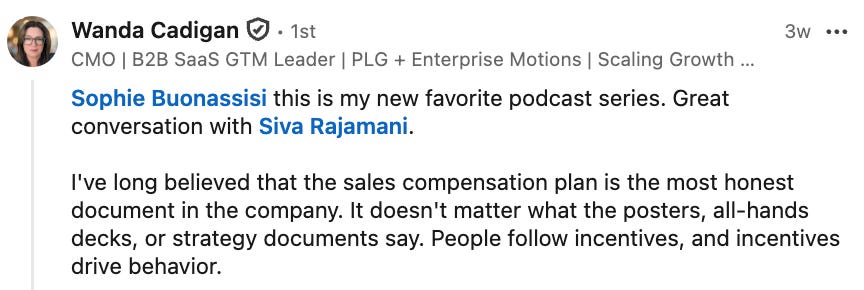
GTM: The Compensation Blueprint for a High-Performing Sales Team
Listen through the links in the page above or by searching wherever you get your podcasts “The GTMnow Podcast.”

Proaction – raised $4.2M to replace legacy fleet management with an AI-native platform. Fleets have been stuck with the same expensive, opaque vendors for decades — Proaction swaps call centers for AI agents and gives operators the visibility they’ve never had.
Ollama – raised a $65M Series B. Its open-source platform lets developers run LLMs locally on their own machines instead of sending data to the cloud. It now has ~8.9M developers, 67,000+ integrations, and is used inside 85% of the Fortune 500.
Velocity – raised a $27M Seed to build monetization and distribution infrastructure for AI-native apps. Six months in, already powering millions of AI interactions daily. As users spend more time in AI products, entirely new monetization models need to be built from scratch.

-
Director, Business Development at Armada (Remote – US)
-
Head of Sales at Kick (Toronto, Canada)
-
Manager, Sales Development at Vanta (Hybrid – NY / SF)
-
Director, Demand Generation at Gorgias (Toronto, Canada)
-
VP of Sales at Closinglock (Austin, TX)
See more top GTM jobs on the GTMfund Job Board.

Upcoming events you won’t want to miss:
-
Lenny & Friends Summit: September 10, 2026 (San Francisco, CA)
-
Dreamforce 2026: September 15–17, 2026 (San Francisco, CA)
-
INBOUND: September 16–18, 2026 (Boston, MA)
-
Pavilion GTM2026: September 28–October 1, 2026 (NYC, NY)
-
Moment 2026: October 6, 2026 (NYC, NY)
-
CVC Week by Counterpart Ventures: September 29, 2026 (San Francisco, CA)
-
Customer Success Week: October 5-9, 2026 (NYC, NY)
-
TechCrunch DISRUPT: October 13–15, 2026 (San Francisco, CA)
-
GTMfund AGM/Retreat: October 15-17, 2026 (San Francisco & Napa, CA)

Some GTMnow Network love to close it out – we appreciate you.